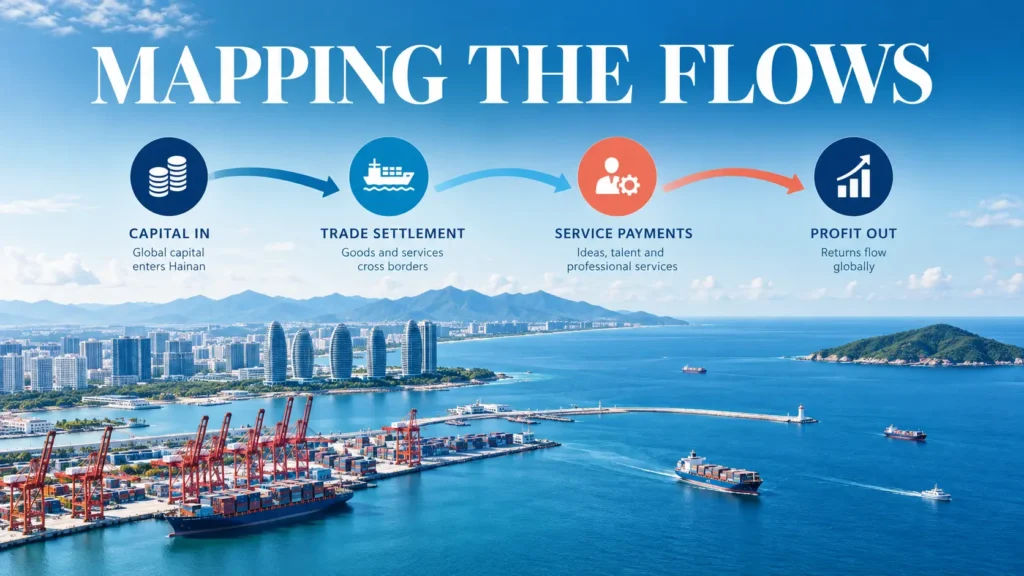
Hainan's multi-functional free trade account, known as the EF account, lets a qualifying company send and receive cross-border funds on payment instructions alone for transfers between the account and overseas, offshore or other EF accounts. It launched on 6 May 2024 under the People's Bank of China Hainan Branch, and by mid-2026 thirteen banks had opened roughly 1,300 of these accounts.
It is not an offshore account, and it is not a shortcut around compliance, tax or bank review. It is a RMB-and-foreign-currency account inside China's regulated banking system that removes several front-end steps for genuine cross-border business.
This guide explains what the account actually does, who can open one, where the boundaries sit, and the questions to settle with a bank before counting on it.
What is the Hainan EF account?
The official name is the multi-functional free trade account (多功能自由贸易账户). “EF” comes from the electronic fence, the ring-fenced accounting framework that separates these accounts from the ordinary domestic banking system. The PBOC Hainan Branch issued the account-management measures in April 2024, and the system went live on 6 May 2024.
Two design choices define it:
- One account, RMB and foreign currencies. The account integrates RMB and foreign-currency subaccounts under a single opening process, with one set of onboarding documents instead of separate foreign-currency account applications.
- Two boundaries. Transfers between an EF account and overseas accounts, offshore (OSA) accounts, non-resident (NRA) accounts or other EF accounts cross the so-called first line and are handled on the basis of the payment instruction. Transfers between an EF account and an ordinary mainland bank account cross the second line and remain managed.
The account type follows the holder. A company registered in the Hainan Free Trade Port, including a foreign-invested one, opens an EFE account. An overseas institution, including Hong Kong, Macao and Taiwan entities, opens an EFN account. This article is written for the foreign-invested Hainan company, the EFE case.
What does “first-line free flow” actually remove?
The phrase that matters is 凭收付款指令办理: for qualifying first-line transfers, the bank acts on the payment instruction rather than demanding the underlying contract, invoice and approval trail before executing. In practice this changes two things.
Speed. Banks and the PBOC Hainan Branch report cross-border transfers that previously took one to two days being completed in minutes to hours when the documentation relationship is already in place. Treat those as reported cases, not a service-level promise: compliance screening, currency, cut-off times and the receiving bank all still apply.
Fewer front-end steps for capital activity. For capital-account transactions other than securities investment, an EFE account holder is not subject to the foreign-debt quota frameworks (the “borrowing-gap” or full-coverage macro-prudential regimes), outbound-lending quotas, or the prior foreign-exchange registrations and special account openings that ordinary companies complete before the money moves. For a company that expects shareholder loans, cross-border lending within a group, or repeated investment flows, this is the substantive benefit, not the headline transfer speed.
Two limits sit on top of all of this. Securities investment is excluded from the capital-account facilitation. And “on payment instruction” never means “without review”: banks remain responsible for customer due diligence, anti-money-laundering and sanctions controls, and they can ask for evidence, delay or decline a transaction that does not hold together.
How does money move between the EF account and the mainland?
Second-line movement is where most planning questions concentrate. The practical rules for a Hainan company:
| Transfer | Treatment |
|---|---|
| EFE account to the company's same-name ordinary RMB account at a Hainan bank | Allowed within a quota in both directions; RMB only |
| EFE account to a different company's mainland account | Treated as cross-border; generally limited to goods-trade settlement with customs import/export treatment |
| EFE account to overseas, OSA, NRA or another EF account | First-line: on payment instruction |
The same-name quota is normally set at one times the company's owners' equity as shown in its prior-year annual report, in each direction. A company registered for less than six months, or unable to provide that report, works with 50% of owners' equity from its latest audited financial statements instead.
A worked example makes the consequence clear. A Hainan trading company with USD 1 million of paid-in equity can move up to the RMB equivalent of USD 1 million per direction per year between its EF account and its ordinary Hainan account. A brand-new company with thin equity has a thin second-line corridor, which means the EF account is most useful when cross-border flows genuinely dominate and mainland transfers are modest.
What can a foreign-owned company use it for?
The account fits companies whose money genuinely crosses borders repeatedly:
- Trade settlement. Paying overseas suppliers and receiving export proceeds, with the conversion between RMB and foreign currency available at the offshore CNH rate inside the account rather than priced transaction by transaction onshore.
- Group funding. Shareholder loans, cross-border lending and treasury movements without the quota and registration sequence that applies to ordinary accounts, subject to the securities-investment exclusion.
- Investment flows. Receiving qualifying inbound investment and handling eligible outbound investment.
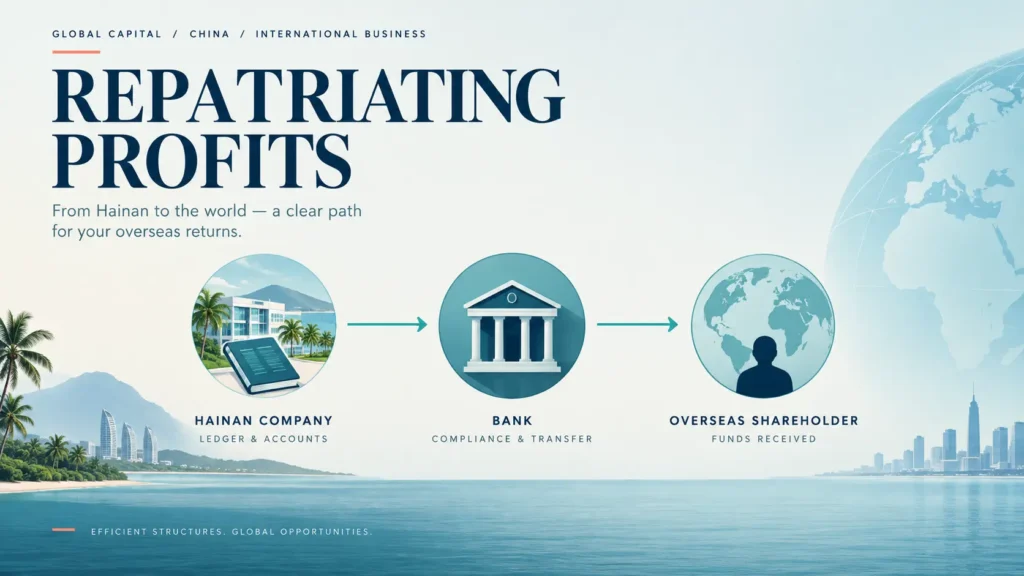
- Profit repatriation. Dividends to overseas shareholders follow the same rules as anywhere else in China: properly determined, audited and taxed profits first. The EF account changes the mechanics of the transfer, not the preconditions. Our profit repatriation guide covers those preconditions.
A company whose revenue is domestic RMB and whose only cross-border flow is an annual dividend gains little. The account earns its keep when cross-border settlement, conversion or group funding is routine.
Who can open one, and where?
Eligibility is assessed by the participating banks under the account-management framework. Thirteen banks offered EF accounts by mid-2026, up from ten at launch, and the PBOC Hainan Branch has said it is working to bring further banks online. In practice, banks look for a real Hainan operating case: a registered company with genuine cross-border activity, coherent ownership and explainable expected flows. That is the same substance test as ordinary bank onboarding, applied to a more capable account. Our guide to opening a business bank account in China covers that baseline assessment.
Adoption has moved quickly: 34 companies opened accounts on launch day, the count passed 120 main accounts within the first seven months, and cumulative transaction volume exceeded RMB 600 billion within roughly two years of launch. Volume figures reflect large state-linked and trading enterprises as much as small foreign-invested companies, so read them as evidence the rails work, not as a typical user profile.
What the EF account does not do
Marketing around the Free Trade Port attaches expectations to this account that it does not carry. Four clarifications:
- It is not an offshore account. The money stays inside China's regulated system, at a Chinese bank, visible to the regulators who designed the fence.
- It does not create tax eligibility. The 15% corporate income tax rate depends on encouraged-industry status and substantive operation, assessed separately. A convenient account changes neither. See our substantive operation explainer.
- It does not bypass documentation permanently. The bank may not demand the contract before executing a first-line transfer, but the transaction still needs to be real, and the bank can and does ask. The documentation routine moves from before each payment to an ongoing relationship discipline.
- It does not cover securities investment. Portfolio flows are outside the capital-account facilitation and follow their own channels.
Where the account succeeds or fails in practice
The EF account is opened by a bank, and banks apply the same commercial judgement here as they do for ordinary accounts. The companies that get value from it share a pattern: the cross-border flow is described precisely before the account is opened, the ownership chain is documented, and the paperwork routine for post-transaction review exists from day one.
The companies that struggle are the ones that open the account as a policy trophy. A Hainan company with no clear overseas counterparty, no expected volume and a vague business description will pass neither the bank's EF onboarding nor its ongoing monitoring. The account amplifies a real cross-border business; it does not create one.
There is also an accounting dependency that few guides mention. Because banks can review transactions after execution, the company's books become part of the account's evidence trail: contracts, invoices and customs records need to reconcile with what actually moved through the account. A company running informal bookkeeping and an EF account is accumulating two problems that will meet each other at review time.
Questions to settle with the bank before relying on it
- Does the bank offer EF accounts to a company of our ownership structure and activity, and what does its onboarding require beyond ordinary account opening?
- Which of our planned flows would actually route through the EF account, and which stay on the ordinary account structure?
- What same-name quota will apply to us, and which Hainan bank branch holds the paired ordinary account?
- How does the bank handle CNH conversion inside the account, and at what pricing?
- What evidence does the bank expect us to keep ready for post-transaction review?
- If we later need flows the EF framework excludes, what is the fallback route?
Bring these to the first meeting, ideally before company registration is finalised, because the answers can affect which bank the basic account should sit with. Our Haikou team coordinates bank preparation, bookkeeping and cross-border documentation for foreign-invested companies as one workstream, because banks review them as one story; describe your flows to us if you want the account structure planned before the licence is issued. For the wider picture of how this account fits alongside capital accounts and the four flows every foreign-invested company must plan, see our Hainan cross-border accounts and fund flows guide.
Common questions
What does EF stand for in the Hainan EF account?
EF stands for electronic fence, the ring-fenced accounting framework that separates these accounts from the ordinary domestic banking system. The official Chinese name is 多功能自由贸易账户, the multi-functional free trade account.
Can a foreign-owned company open an EF account in Hainan?
Yes. A foreign-invested company registered in the Hainan Free Trade Port can open an EFE account at a participating bank, subject to the bank's eligibility assessment. Overseas institutions open the sister account type, the EFN account.
Is the Hainan EF account an offshore bank account?
No. The account sits at a Chinese bank inside the regulated financial system. It applies a separate accounting framework for cross-border flows, but funds, banks and transactions all remain within China's regulatory perimeter.
Can I move money freely between an EF account and a mainland account?
No. Transfers to the mainland cross the “second line” and are managed. RMB transfers to the company's same-name ordinary account at a Hainan bank are allowed within a quota linked to owners' equity; other mainland transfers are generally limited to goods-trade settlement.
Does an EF account remove foreign-exchange registration for shareholder loans?
For capital-account transactions other than securities investment, EFE account holders are not subject to the ordinary foreign-debt quota frameworks or the prior foreign-exchange registrations and special-account steps. The loan itself still needs to be genuine and documented.
Related reading
- Hainan cross-border accounts and fund flows
- Open a business bank account in China
- How to repatriate profits from China
- Hainan substantive operation: what the test requires
- Hainan Free Trade Port company setup
Official sources
- People's Bank of China Hainan Branch: multi-functional free trade account launch and framework
- Hainan provincial government: EF account uptake and pilot banks
- Sanya government investment portal: EF account convenience features and 2026 adoption figures
- State Administration of Foreign Exchange
Account rules, participating banks and quota details are set by the PBOC Hainan Branch framework and each bank's implementation, and they continue to evolve. Confirm current conditions with the bank before structuring flows around the account.
Read our editorial standards and corrections policy
Thanks for your feedback.