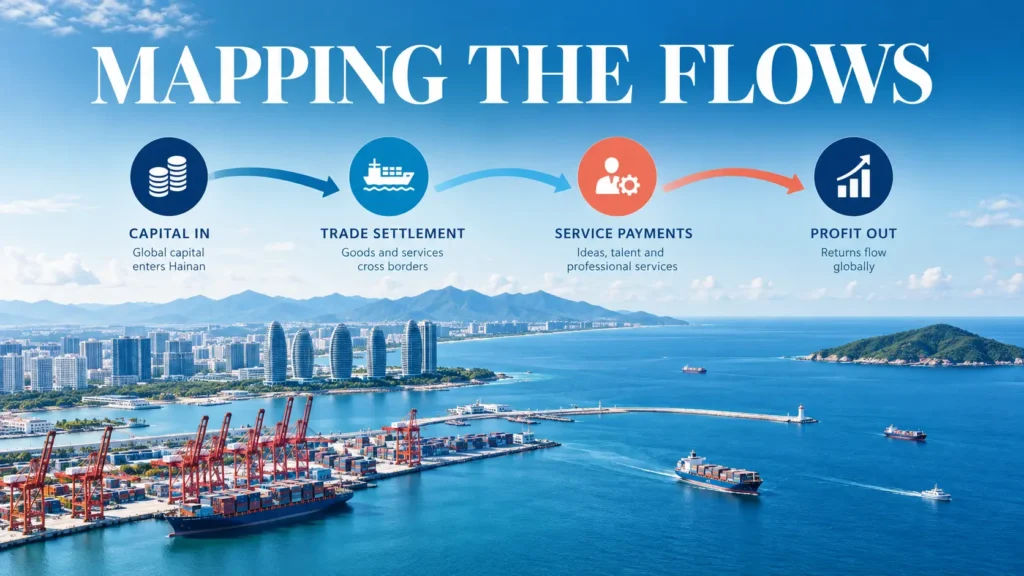
Foreign investors are allowed to remit lawful profits from a Chinese company. The process is not an informal bank transfer: the company must have distributable profits, complete the required corporate and tax steps and give the bank enough information to verify the transaction.
When those records are clean, dividend remittance is a normal corporate procedure rather than a special exit permission.
What can be sent overseas?
China’s foreign investment framework protects the lawful transfer of capital contributions, profits, capital gains, disposal proceeds, intellectual-property royalties, compensation and liquidation proceeds in renminbi or foreign currency.
Each type of payment has its own legal, tax and banking basis. This article focuses on dividends from a Chinese subsidiary to its overseas shareholder.
If the overseas shareholder is a foreign individual rather than a company, read our foreign-individual dividend tax guide before applying the corporate withholding discussion below.
The usual dividend-remittance process
1. Confirm distributable after-tax profit
Dividends come from accumulated after-tax profit shown in the company’s accounts. Prior losses must be covered and required allocations, including the statutory reserve where applicable, need to be addressed before distribution.
2. Approve the distribution
The shareholder or competent company body adopts a written profit-distribution resolution consistent with the articles of association and financial statements.
3. Complete the tax treatment
Dividends paid to a non-resident corporate shareholder commonly attract 10% withholding enterprise income tax. An applicable tax treaty may reduce the rate if the shareholder qualifies and keeps the required evidence.
4. Submit the bank’s supporting documents
The bank reviews the transaction for authenticity and compliance. It may request the business licence, shareholder resolution, financial statements, tax information, foreign direct investment registration details and information about the overseas recipient.
Requirements vary with the transaction and bank. Ask the bank for its current checklist before signing the resolution so that names, amounts and payment descriptions match.
Can registered capital be sent back?
Registered capital is not a dividend account. Returning capital normally requires a lawful capital reduction, equity transfer, liquidation or another recognised transaction, together with company registration, creditor-protection and tax procedures.
Do not move capital out under a service invoice that does not match a genuine service. Artificial contracts and mismatched pricing create tax and foreign-exchange risk.
What if the foreign shareholder reinvests the profit?
China introduced a tax-credit policy for qualifying direct investment made from distributed profits between 1 January 2025 and 31 December 2028. A qualifying overseas investor may receive a tax credit calculated at 10% of the investment, or at a lower applicable treaty dividend rate.
The policy covers specified equity investments and has reporting, use and holding-period conditions. It should not be summarised as a permanent “0% dividend tax”.
Hainan’s foreign investment regulations also support reinvestment. Current Hainan policy materials state that foreign-invested enterprises can be exempt from domestic reinvestment foreign-exchange registration in qualifying circumstances, reducing one administrative step. Tax and corporate procedures still apply.
Does Hainan make cross-border payments easier?
Hainan is expanding cross-border financial services, including multifunctional free trade accounts and higher-level trade and investment facilitation. Banks also handle specified foreign-exchange registrations directly.
That does not remove transaction review. A bank still needs to understand who is paying, who is receiving, why the payment is lawful and whether taxes and registrations are complete.
The best banking conversation happens before the first capital transfer. Explain the expected currencies, capital contributions, overseas service payments, royalties and dividend schedule when selecting a bank.
Documents worth keeping from day one
- shareholder and investment documents;
- capital contribution records;
- contracts and invoices for cross-border transactions;
- tax filings and payment records;
- audited or otherwise required financial statements;
- board or shareholder resolutions;
- foreign-exchange registration information; and
- evidence supporting treaty benefits.
Profit remittance becomes difficult when the company tries to reconstruct several years of records at the time of payment.
Related reading
- China corporate tax for foreign companies
- Hainan’s 15% corporate income tax: who qualifies?
- Annual compliance for a foreign-owned company in Hainan
Official sources
- Regulations on Foreign Investment in the Hainan Free Trade Port
- Tax credit for foreign investors reinvesting distributed profits
- Hainan opening-up policy framework
- Bank registration documents for a new foreign-invested enterprise
Banks and tax authorities assess the actual transaction. Confirm the current document and treaty requirements before declaring or remitting a dividend.
Read our editorial standards and corrections policy
Thanks for your feedback.