The bank account is the step that most often decides when a new Chinese company can actually start working. Registration follows a defined procedure. Bank onboarding involves a commercial decision by an institution that is not obliged to accept you.
Founders who plan for this treat account opening as a project with its own preparation. Founders who assume it follows automatically from the business licence are the ones who lose weeks.
This guide explains what banks are assessing, which accounts a foreign-invested company needs, and how to prepare so the first application succeeds.
Why the licence does not guarantee an account
Company registration and bank onboarding answer different questions.
The registration authority asks whether the application meets the filing requirements. The bank asks whether it is willing to take on this customer, and it applies its own customer due diligence to decide.
That means a complete, properly registered company can still face questions, delays or a refusal. It also means the outcome depends heavily on how well the business can be explained and evidenced, not only on whether the paperwork exists.
Until the account is open, the company generally cannot receive capital in the normal way, cannot pay suppliers, and cannot run payroll.
The accounts a foreign-invested company uses
Most newly established foreign-invested companies deal with two categories.
The basic RMB settlement account is the company's primary operating account. It handles day-to-day receipts and payments, tax payments and payroll. A company normally has one basic account, and it is usually the first one opened.
Foreign-exchange and capital accounts handle cross-border flows. Foreign direct investment information registration is completed through a bank, and where the company will receive capital contributions from overseas shareholders, a capital account is normally required. The specific account structure depends on the company's activity and the bank's arrangements.
Trading companies may need additional arrangements for settlement of imports and exports. Confirm the full account structure with the bank before opening the first one, so the sequence works.
What the bank is actually assessing
Understanding the bank's perspective changes how you prepare. In practice they are testing four things.
Is the business real and explainable? What the company sells, who its customers are, where its revenue will come from, and whether the described model is coherent. A business scope that reads as a list of unrelated activities invites questions.
Who ultimately owns and controls it? The ownership chain up to the beneficial owners, and who holds authority to operate the account. Multi-layer offshore structures require more explanation than a direct shareholding.
Does the company have a verifiable presence? The registered address and the ability to demonstrate that the company operates from somewhere identifiable. Some banks conduct site verification.
Do the expected flows make sense? Anticipated transaction volumes, counterparties and countries. Flows that are inconsistent with the stated business model are the most common trigger for further review.
Documents to prepare
The exact list is set by the bank, and it varies. Expect to provide:
- the business licence;
- the company's official seals;
- articles of association;
- identification for the legal representative and for authorised signatories;
- shareholder documents, including the overseas entity's registration documents where a company is the shareholder;
- evidence of the ownership chain and beneficial owners;
- registered address documents, and often a lease;
- tax registration information; and
- a description of the intended business, customers and expected flows.
Two practical points. First, the legal representative's attendance is commonly expected, and some banks require it. Second, documents issued overseas may need certification, by apostille where the issuing country is covered by the Apostille Convention or by consular legalisation otherwise.
Where applications get delayed or refused
Most problems fall into recognisable patterns.
The business explanation is thin. The applicant describes the company in generic terms and cannot name expected customers or explain how revenue arises.
The business scope does not match the described activity. The bank reads the scope on the licence and hears something different in the interview.
The address cannot be verified. An address adequate for a filing requirement may not satisfy a bank that wants to see where the company operates.
The ownership chain is opaque. Layered offshore entities without clear documentation of who ultimately owns and controls the company.
The expected flows look inconsistent. Large anticipated cross-border volumes for a newly established company with no operating history and no explanation of the underlying trade.
The wrong bank was approached. Banks differ in their appetite for foreign-invested customers, for particular industries and for smaller companies. A refusal is sometimes a mismatch rather than a defect in the application.
How to prepare so the first application works
- Choose the bank before you finalise the address and scope. Requirements differ, and some are easier to satisfy at the planning stage than after registration.
- Write the business description before the interview. One page: what the company sells, to whom, how it gets paid, expected monthly volumes and main counterparty countries.
- Make sure the scope, the description and reality agree. These three should tell the same story.
- Confirm who must attend, and when. Plan travel around it if the legal representative is required in person.
- Prepare the ownership chain as a diagram. Show entities, jurisdictions and percentages up to the beneficial owners.
- Sequence the accounts correctly. Basic account, foreign direct investment information registration, then capital account where needed.
- Have a second bank identified. A refusal is not fatal if you have not spent your entire timeline on one application.
Timing and what it blocks
Account opening runs in parallel with other post-licence work, but several things depend on it.
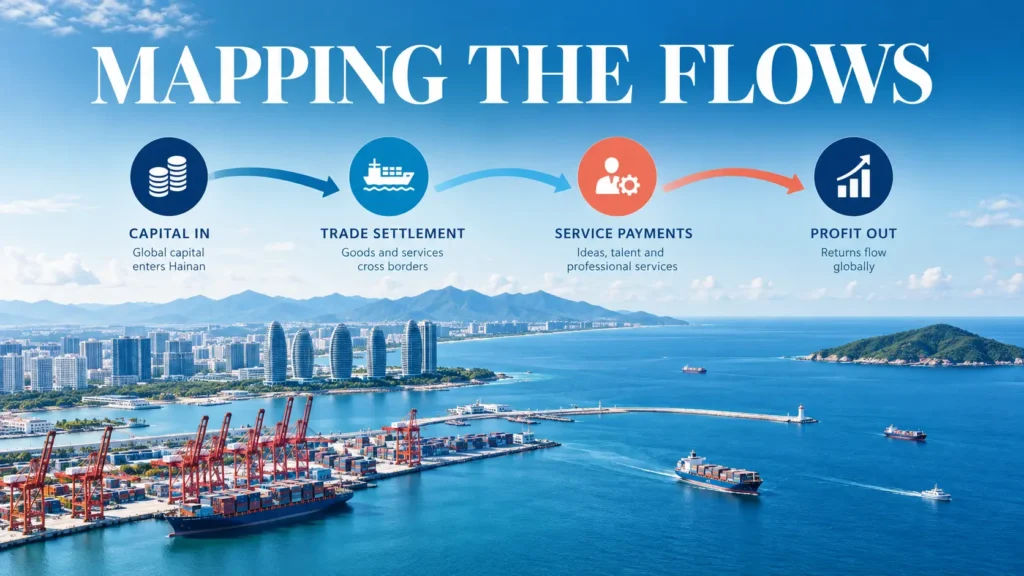
Capital injection normally requires the account structure to be in place. Payroll requires an operating account. Supplier payments and customer receipts both require it. Foreign-exchange procedures for cross-border flows run through the bank.
Plan the company's launch date from the account, not from the licence.
The Hainan angle
Hainan's Free Trade Port framework includes measures aimed at cross-border financial services, and the practical availability of any specific arrangement depends on the bank, the company's activity and the rules in force.
Two points worth keeping separate. Convenient banking arrangements do not by themselves create eligibility for tax benefits, and a preferential tax position does not simplify bank onboarding. Each is assessed on its own criteria.
If cross-border settlement is central to your model, discuss the account structure with the bank before choosing where to register.
Related reading
- How to register a WFOE in China
- How to register a company in China as a foreigner
- China registered capital rules and the five-year deadline
- How to repatriate profits from China
- Hainan cross-border accounts and fund flows
Official sources
- State Administration of Foreign Exchange
- People's Bank of China
- Guide to business establishment registration of foreign-invested enterprises
- China's implementation of the Apostille Convention
Bank requirements, document lists and processing times are set by each institution and change over time. Confirm the current requirements with the chosen bank before planning around a date.
Read our editorial standards and corrections policy
Thanks for your feedback.